
A few Hall-of-Famers and some lesser-known workhorses make up the pitching slate for Round 7. Since I am making the pitching matchups based on total victories and total saves, we are starting to see pitchers who did not manage a winning career record; this should provide increased offense in this and successive rounds.
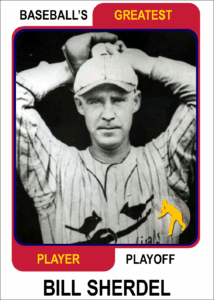
Played as: Bill Sherdel
Full Name: William Henry Sherdel
Nicknames: Wee Willie
Lifetime: 165-146, 26 Saves, 3.72
A slow-ball specialist for the 1920s St. Louis Cardinals, Bill Sherdel made his mark with durability as a starting pitcher and the ability to come in in relief to put out the fires set by his predecessors. One of the top left-handers of his time, he bloomed under the management of Rogers Hornsby and the mentorship of Pete Alexander, who will also be featured this round. He had nothing but hard luck in his World Series appearances, losing 4 games to the New York Yankees, despite an ERA of 3.26.
Quotable: “The little southpaw, uses a slow ball, then a slower one, and sometimes one which hardly comes to the plate.” – The Sporting News
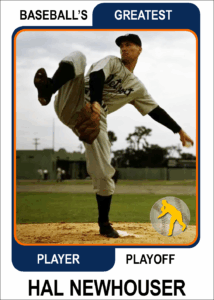
Played as: Hal Newhouser
Full Name: Harold Newhouser
Nicknames: Prince Hal, Hurricane Hal
Lifetime: 207-150, 26 Saves, 3.06
Hall of Fame – 1992
Underrated because he dominated the competition during World War II – he proved his abilities when he dominated opposing batters after it, as well! – Hal Newhouser was the top AL pitcher from 1944-49, winning TWO MVP awards in 1944 and 1945 and finishing second in the voting in 1946.
Quotable: “I didn’t win because I controlled my temper, I controlled my temper because I began to win. … There’s no use getting mad when you’re winning!”
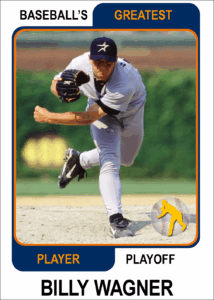
Played as: Billy Wagner
Full Name: William Edward Wagner
Nicknames: Billy the Kid
Lifetime: 47-40, 422 Saves, 2.31
Hall of Fame 2025
A seven-time All-Star, Billy Wagner was one of the most dominant closers in the game and was consistently among the league leaders in saves throughout his 16-year Major League career. In his final outing before retirement, he struck out the last four batters he faced: Raúl Ibañez (Finished #438 in the Playoff), Shane Victorino, Brian Schneider, and Greg Dobbs.
Quotable: “It’s tough to blow three games in a row and have the courage to go back out there. But if you go through what I went through as a kid, not knowing if I was going to eat or who I was going to live with, this is nothing.”
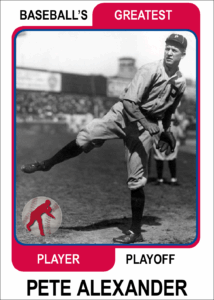
Played as: Pete Alexander
Full Name: Grover Cleveland Alexander
Nicknames: Old Pete
Lifetime: 373-208, 32 Saves, 2.56
Hall of Fame 1938
He doesn’t get the plaudits of Christy Mathewson, but when he retired, everyone thought Pete Alexander had more career victories (it took a later, closer look at the data to determine that their win totals were the same). Physically damaged by his service in World War I, his PTSD, and epilepsy, alcoholism damaged what was left of his reputation.
But you cannot deny his pitching greatness: Still tied for third in career wins, second in shutouts with 90 (Clayton Kershaw is the leader among active players with 15 – that’s not a typo!), four Pitching Triple Crowns, and a lifetime WHIP of 1.121.
Quotable: “Pete, wake up…Rajah wants ya…now!” Alexander awakened from his bullpen “siesta” during Game 7 of the 1926 World Series. Allow me to translate: Rajah refers to St. Louis Cardinals manager, Rogers Hornsby.
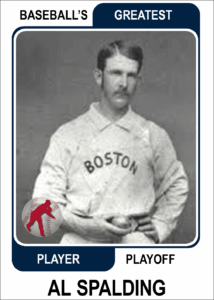
Played as: Al Spalding
Full Name: Albert Goodwill Spalding
Nicknames:
Lifetime: 251-65, 13 Saves, 2.13
Hall of Fame 1939
Before he became a household name in the sporting goods industry and before he helped found the National League, Albert Goodwill Spalding was the best pitcher in the National Association, leading the league in victories in all five years of its existence. Admittedly, it was a different game back then – Spalding and all pitchers threw underhand – but statistically, he should be a tough opponent for the hitters this round.
Quotable: “Everything is possible to him that dares.”
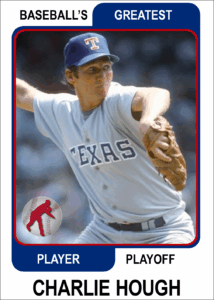
Played as: Charlie Hough
Full Name: Charles Oliver Hough
Nicknames: None
Lifetime: 216-216, 61 Saves, 3.75
Adding the knuckleball to his repertoire after picking up a sore arm in the minors, Charlie Hough went on to a 25-year major league career, pitching for four different teams. After eleven years as a reliever, he transitioned into a starting pitcher at the age of 34 and stayed in the rotation for the remainder of his time in the big leagues.
Never really a superstar, Hough was an extremely competent inning-eater who managed to win more than 200 games. He wore number 49 to honor Hoyt Wilhelm, the Hall-of-Fame knuckleballer who pitched to that age.
Quotable: “I had average stuff, and now I had a sore arm. If you want to compete, you compete. You find something.” – Charlie Hough to Tyler Kepner of The New York Times
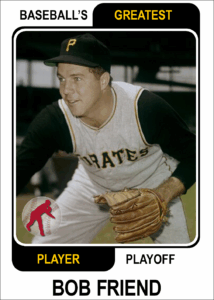
Played as: Bob Friend
Full Name: Robert Bartmess Friend
Nicknames: Warrior
Lifetime: 197-230, 10 Saves, 3.58
A perfect example of the limitations of the Win-Loss record in determining the caliber of a pitcher: Bob Friend is the only Major League pitcher to lose over 200 games without winning more than that total. Playing for some lackluster Pirate teams in the 1950s and 60s, he nonetheless maintained a sub-1.3 career WHIP and a 107 ERA+. Thanks to his good control, with a little more run support, his record might have been reversed.
Quotable: “I was able to pitch every third or fourth day for more than ten years and not miss starts.” – Clifton B. Parker interview of Bob Friend, November 17, 2012.
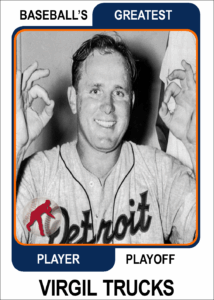
Played as: Virgil Trucks
Full Name: Virgil Oliver Trucks
Nicknames: Fire
Lifetime: 177-135, 30 Saves, 3.39
A hard-throwing right-hander (Ted Williams said he was the fastest he ever faced), Virgil Trucks pitched for five American League teams and was named to two All Star teams. In 1952, he tossed two no-hitters. He lost two years of playing time during World War II, which likely cost him the opportunity to gain his 200th win. He joins former teammate Hal Newhouser in this round.
Quotable: “Why wasn’t I traded to [the Yankees] in 1941? Because I’d definitely be in the Hall of Fame if I had been traded to [them].”
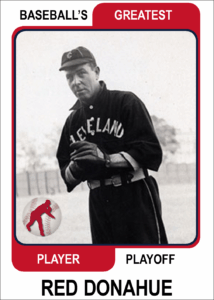
Played as: Red Donahue
Full Name: Francis L. Donahue
Nicknames:
Lifetime: 164-175, 3 Saves, 3.61
Don’t let that won-lost record fool you; Red Donahue was a pretty competent pitcher. He just had a few years with a very weak team. Pitching for the twelfth and last-place National League St. Louis Browns in 1897, (29-102 .221), Donahue went 10-35, setting the record for most losses from the 60ft-6in pitcher’s mound. From 1898 to his retirement in 1906, he won 147 and lost 115 for a .561 winning percentage, winning more than 20 games three times.
Quotable: “Frank has a bitter tongue in his head and ball players as a rule never forgive those who try to hang them up to ridicule.” – Washington Evening Star